38 ടൺ RDF ഡാൽമിയ സിമന്റ് ഫാക്ടറിയിലേക്ക്..
26,065 ടൺ ലെഗസി മാലിന്യ നിർമാർജനത്തിന് വേഗം കൂട്ടുന്നു….
38 Tonnes of RDF Sent to Dalmia Cement Factory
Pace accelerated to clear 26,065 tonnes of legacy waste...
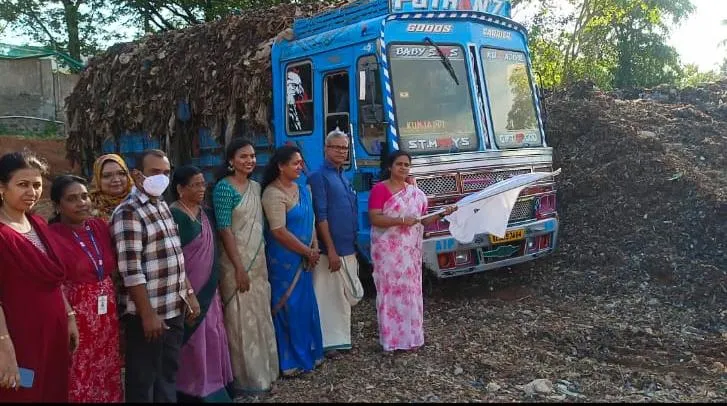
A major milestone has been achieved in the biomining project aimed at finding a scientific solution to the legacy waste that has accumulated over the years at Kurukkanpara in Kunnamkulam Municipality. A consignment of 38 tonnes of Refuse Derived Fuel (RDF), separated through biomining, was flagged off to the Dalmia Cement factory in Dalmiapuram by the Kunnamkulam Municipal Chairperson.
The biomining process at the Kurukkanpara dumpsite is being carried out under the leadership of Kunnamkulam Municipality as part of the Kerala Solid Waste Management Project (KSWMP). The project scientifically removes 26,065 tonnes of legacy waste that accumulated here over decades. The waste heap, measuring roughly 32,582 cubic meters, spanned an area of 1.80 acres.
Through biomining efforts so far, approximately 4,430 tonnes of waste have been processed and segregated into RDF, Bio-earth, and Inert categories. Out of the segregated RDF, a total of 64 tonnes has already been removed from the site, which includes the 38 tonnes dispatched to Dalmia Cement Factory today. The remaining RDF will be shifted to the cement factory in phases to be used as alternative fuel for cement manufacturing. The RDF primarily consists of plastic-based waste recovered through segregation.
Kurukkanpara served as an active dumping ground from 1946 to 2016. Waste that lay buried underground and piled up for decades is now being excavated and scientifically processed.
The waste heap had long been a source of anxiety for local residents due to foul odors, rainwater runoff, leachate generation, risk of groundwater pollution affecting nearby wells and water sources, mosquito and fly infestations, environmental hazards from plastic waste, and fire hazards. As the waste remained underground for years, drinking water security for families relying on local groundwater sources became a primary concern, while the stench and environmental issues disrupted daily life.
The municipality is executing this biomining project to find a permanent remedy to these longstanding problems and eradicate the dump site completely. Biomining extends beyond merely clearing the heap; its core objective is to segregate waste into distinct categories and ensure scientific post-processing and recovery for each.
Excavated waste is dried for 5 to 7 days before being segregated using trommel screens, primarily yielding RDF, Bio-earth, and Inert material. Converting plastic-based fractions into RDF for industrial cement production provides a productive end-use for waste that sat stagnant for decades.
The resulting Bio-earth and Inert materials will undergo rigorous testing based on CPHEEO guidelines to ensure they are safe for reuse. Soil samples from the bottom of excavated pits will also be tested to verify the absence of contamination. Once confirmed safe, the tested soil alongside Inert and Bio-earth fractions will be utilized for backfilling. Upon completion of biomining, the cleared land will be reclaimed and restored for municipal developmental purposes.
The successful completion of the Kurukkanpara biomining project will resolve the longstanding legacy waste crisis, pave the way for resource recovery, and restore valuable land. Transforming waste into RDF and utilizing it as fuel for cement production marks a sustainable new lifecycle for the waste at Kurukkanpara.
Municipal Vice Chairperson P.G. Jayaprakash, Standing Committee Chairpersons Pushpa John, Misha Sebastian, and Arsha Jiju, Senior Public Health Inspector Sunil, Raji, and SWM Engineer Muhseena attended the event.